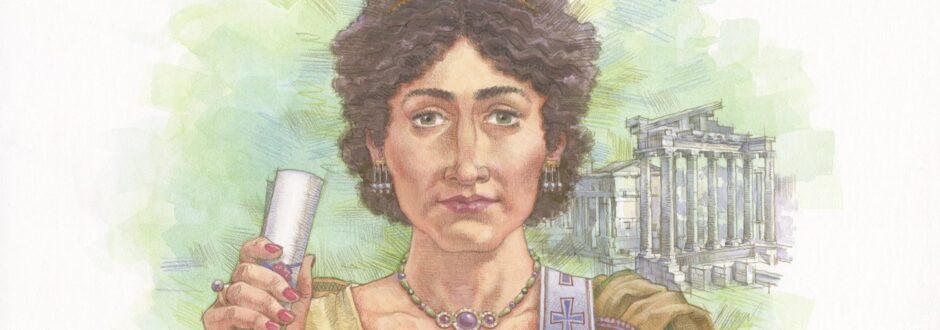
The Church continues to be awash and overwhelmed with maleness. And like the fish being the last to discover water, a great many Catholics fail to notice, let alone be disturbed, by this reality, writes Good Samaritan Sister Patty Fawkner.
In language, preaching, proclamation, authority, and in key decision-making roles, the Church continues to be overwhelmingly masculine and patriarchal. So, it was no surprise, but no less disturbing, that yet another report commissioned by Pope Francis and made public by Pope Leo in December 2025, rules out the possibility of women deacons.
There is a caveat. There is no possibility “at this time”. For me, this phrase fails to soften the harsh reality of evasion, delay tactics and ultimate exclusion.
In his first encyclical, Dilexi Te, promulgated in October 2025, Pope Leo noted that “the organisation of societies worldwide is still far from reflecting clearly that women possess the same dignity and identical rights as men.” He went on to say, “We say one thing with our words, but our decisions and reality tell another story.” (#12)
So true and so ironic.
Appeals to tradition continue to be invoked “at this time”. Yet tradition is something living rather than a fixed museum piece. It is of the Spirit’s essence to always speak afresh. May not the Spirit be speaking afresh in our present historical moment – especially regarding women’s roles?
We are told that Jesus only chose 12 male apostles, but isn’t Mary Magdalene the “Apostle to the Apostles”, she being the first one to encounter and proclaim the risen Christ?
What has become a tradition within the Catholic Church is to insist on the complementarity of the sexes, a concept that has so often been proven to be dangerous to women.
Pope John Paul II began a tradition of profusely thanking women for their contribution and exalting them almost mystically, while continuing to deny them an equal voice in governance and in the Church’s sacramental life. Women are welcomed as helpers but not ultimate decision-makers. As Pope Leo says, “we say one thing with our words, but our decisions and reality tell another story”.
Appeals to theology, a dubious theology at that, are made by those opposed to women’s ordination as reported in the Vatican News:
The masculinity of Christ, and therefore the masculinity of those who receive Holy Orders, is not accidental, but is an integral part of sacramental identity, preserving the divine order of salvation in Christ. To alter this reality would not be a simple adjustment of ministry but a rupture of the nuptial meaning of salvation.
“The nuptial meaning of salvation.” To quote Pauline Hanson, “Please explain”.
The logic of this proposition is that Jesus was male, the risen Christ is male and the Church is female because she is the ‘Bride of Christ’. This legitimate poetic metaphor for the relationship between the Church and Christ, becomes rigidly literal, leading to structures that exclude.
The subtext is that priests (men) image Christ in a way women do not. This is patriarchy and hierarchy at work. Surely Christ’s ‘masculinity’ is not theologically essential to his saving role.
In Scripture we are presented with other understandings of salvation such as liberation, the coming of the new creation, discipleship, adoption and participation in the Body of Christ, images which are more inclusive and less gendered.
The continuing ban on women’s ordination to the diaconate reminds me of an event I attended a few months ago, when the Lawson parish community celebrated a Mass to thank and farewell the Good Samaritan Sisters who had served in the Blue Mountains area for nearly 100 years.
At the beginning of Mass, six adults occupied the sanctuary – two priests, one deacon, two altar servers and an MC – all male.
Towards the end of Mass, three politicians were invited to speak – the Federal Minister, the State Member and the Deputy Mayor – all female. A potent ‘sign of the times’.
These three women were warm, articulate, competent and inclusive of each other and of the congregation.
It occurred to me then, as it does now, how anachronistic the Church continues to be regarding women. The visible absence of women in ordained liturgical leadership is in sharp contrast to the roles women play in civil society.
With this latest exclusion of women to the diaconate, I feel demoralised, disappointed and, above all, deeply sad that our Church, which, let’s be honest, wouldn’t function without women’s contribution, puts stringent boundaries on this contribution and in so doing limits the efficacy of the Church’s mission.
Of course, there have been advancements. During Pope Francis’ papacy, and now that of Pope Leo, we have seen significant and tangible progress in many Vatican appointments and their commitment to synodality – a way of being church that involves dialogue, discernment and respect for diversity.
The concept of synodality is founded on a deepened understanding of baptismal equality. Women, as well as men, are made in the image of God and participate fully in the priesthood of believers.
The Church will become fully synodal only when women are present, seen and heard equally in all aspects of Church life including preaching, proclamation, authority and in key decision-making roles.
Women already practice Diakonia, that rich Greek term which essentially means compassionate service to others in imitation of Jesus. We know that there were women deacons in the early Church, but contemporary opponents of women deacons argue that though they existed they had a different function than ordained male deacons.
I hope and pray that one day for those women who feel called, their service will be officially recognised by allowing them to be ordained as deacons with the same function as their male counterparts.
