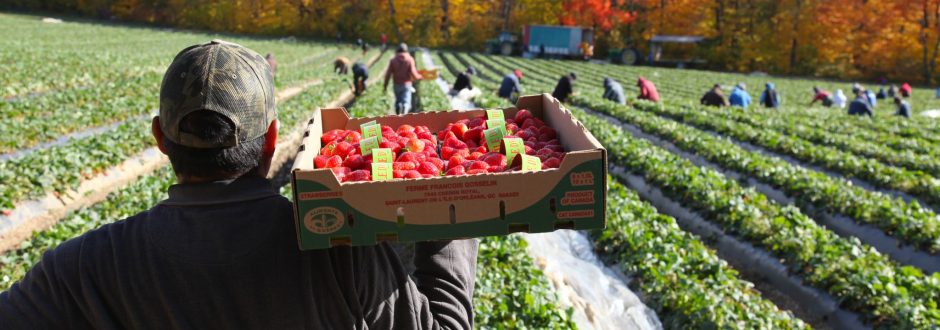
Human trafficking, modern slavery and the vulnerability of migrant workers was the focus of this year’s Good Samaritan Refugee Week Conference, which explored the theme of ‘Hidden Slavery in Australia’.
By Debra Vermeer
The online conference was hosted by the Good Samaritan Refugee and Asylum Seeker Support Network (GRASSN) as a means of raising awareness of the issues both among the Sisters and across the broader Good Samaritan community.
Guest speakers included Good Samaritan Sister Sarah Puls, who is the National Executive Officer of ACRATH (Australian Catholic Religious Against Trafficking in Humans), and Carla Chung, who works for ACRATH as a migrant support worker with a specific focus on the Pacific Australia Labour Movement (PALM) scheme. Carla’s position is funded by the Sisters of the Good Samaritan.
The conference also featured a video of Dindo, a migrant worker and asylum seeker who offered his first-hand experience of some of the challenges faced by people who come to Australia seeking a better life.

Sister Catherine Norman SGS. Photo credit: Sisters of the Good Samaritan.
Good Samaritan Sister Catherine Norman from the GRASSN committee said she had suggested the topic of ‘Hidden Slavery in Australia’ as the result of personal experience of encountering the vulnerability of migrant workers in local areas.
Catherine, who is based in the Hunter region of New South Wales, said she had heard complaints about the treatment of migrant workers in a local abattoir.
“I talked to one of our parish’s social justice committee members and he said to ring the meatworkers’ union about it. So, I did, and I saw that the union was very active in supporting workers in this area, so that was my first experience of this,” she said.
“Then, of course, we know of people from Kiribati who have been coming over here as part of the PALM scheme and are aware of some of the problems they face as well.
“These workers are all very vulnerable and if they are exploited by an employer, they have very little choice but to apply for protection or bridging visas and they are often not allowed to work on bridging visas, which creates further vulnerability. So, these issues are very much tied in with migration, refugees and asylum seekers.”
Sarah began her presentation by explaining the definitions of human trafficking, modern slavery and their relationship to refugees and asylum seekers, saying that human trafficking is one of the fastest-growing crimes in the world with 50 million people globally currently living in slavery and an estimated 41,000 people living in slavery-like conditions in Australia.

Sister Sarah Puls SGS, National Executive Officer of ACRATH. Photo credit: ACRATH.
She said human trafficking was defined by the United Nations Palermo Protocol as having three features. The first is The Act: The recruitment, transportation, transfer, harbouring, or receipt of persons. The second is The Means: The threat or use of force, coercion, abduction, fraud, deception, abuse of power, or taking advantage of someone’s vulnerability. And the third feature is The Purpose: The goal is always exploitation.
Modern slavery, meanwhile, is used in Australia as an umbrella term to describe many different situations where coercion, threats, or deception are used to seriously exploit people and strip away their freedom to make independent choices.
“One of the things for refugees and asylum seekers is that they may not have been trafficked, but they can still be in situations of modern slavery,” Sarah said.
“However, they may also have been trafficked, so there’s potential for them to be at risk in a number of different ways.
“My presentation looked at those situations and then looked at the intersection with refugees and asylum seekers.”
Sarah also outlined ACRATH’s role in advocating for change, supporting victim/survivors, raising awareness, equipping frontline workers in a range of areas including healthcare to identify situations of possible slavery or exploitation, and building regional networks against human trafficking and slavery.
Carla’s presentation focused on her work with migrant workers in the PALM scheme.
“A lot of what I do in my role with ACRATH is trying to be present to migrant workers, to be the eyes and ears, and to be supportive, so that they don’t feel like they are alone when they’re away from home,” she said.
“In my presentation I explained that faith communities can also be a really important support network because many of these migrant workers from the Pacific and Timor Leste find their local church community as a sanctuary, with people they can trust.”

Carla Chung, ACRATH migrant support worker. Photo credit: ACRATH.
Carla spoke about how migrant workers in the agricultural sector often get paid only according to what they pick, so periods of bad weather or seasonal fluctuations in produce can leave them in a vulnerable financial position, which may lead them to take up more exploitative work to make ends meet.
“It was great for me to connect with the Good Samaritan Sisters through this presentation with the hope that I could establish a support network to help us when we identify vulnerable people,” she said.
The conference also featured a video presentation from Dindo, an asylum seeker from the Philippines, who said that when he was approached by acquaintances to consider moving to Australia to work, he was promised “a land of milk and honey”.
“We were promised a better life away from the struggles experienced in our country,” Dindo said. “Alas, our dreams were cut short. Every promise that was made was never fulfilled and, unfortunately, we feel like we were the victim of human trafficking and this experience was about making money from my family.
“We spent our life savings to come here, and we were stuck with no friends or relatives or help.”
Dindo said he was often not paid for the work he did and an application for a student visa was denied, leaving him with no Medicare coverage or work rights. He is now applying for a protection visa.
“So, my future is uncertain and all I have is my faith in God and the people in the community who give me hope,” he said.
Catherine said the three presentations, followed by a Q and A session, gave excellent insights into the issues of human trafficking and slavery, and helped equip the audience with practical ways to be alert and responsive to the problem in their own communities.
“The highlight for me was the fact that here we had a Good Samaritan Sister, and somebody whose position is funded by the Good Samaritan Sisters, actually out there and engaged in this work at such a high level,” she said. “It was wonderful to hear their first-hand accounts of the work being done in the community in keeping an active eye out for this kind of exploitation and also in supporting people.
“It encouraged us to know that parishes and faith communities really can play a role in helping out in a practical way and being alert to the issues and the terrible situations that people around us can be living in.”
