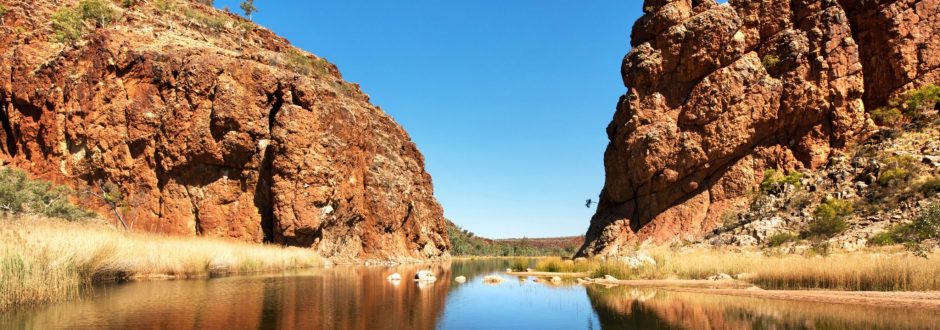
I am thankful that Australia has a history of broad cultural diversity where our differences were not barriers, but instead made for more interesting and enriching connections, writes Congregational Leader Sister Catherine McCahill.
I love a sunburnt country,
A land of sweeping plains,
Of ragged mountain ranges,
Of droughts and flooding rains.
I love her far horizons,
I love her jewel-sea,
Her beauty and her terror –
The wide brown land for me!
(My Country – Dorothea Mackellar)
Yes, I love this land that I call my home, a land of contrasts, of beauty and terror. I love its unique flora and fauna, its “colossal biodiversity” (Wild Australasia).
I have lived in the tropical north with its cyclones, rainforests and rich volcanic soils and I have lived on the edge of the desert with its ancient landforms, red soil, spinifex and salt bush. I know also the cold and unpredictable seasons of the southeastern corner of this big country. I can say, I love it all.
More than its landscapes, however beautiful and majestic, my greater love is for the people and the cultures of this sparsely populated continent.
These days, I am disturbed by the political and social commentary that seeks to erode and criticise the social constructs of our society. I am appalled that some of us have used their political voice to promote monoculturalism. However, I am more appalled that other political leaders are slow to critique such rhetoric.
The peoples of this land have never, from my perspective, been monocultural. The first peoples of this land spoke more than 250 languages with about 800 dialects (Australian Institute of Aboriginal and Torres Strait Islander Studies). The customs, law, creation myths, food, agrarian practices and much more varied across the country, including the Torres Strait.
Born in North Queensland in the 1950s, from my early years, I was familiar with different cultural practices among the Indigenous people I encountered. Of course, my knowledge was limited, but as a young person I knew at least some of the cultural differences between the Aboriginal people and the Torres Strait Islander people who lived in our suburb.
In our neighbourhood, I knew Polish and German families from Europe. The older children and their parents had arrived as refugees and built their homes and raised families, as had my parents.
At school, two of my classmates were Chinese Australians – their grandparents had arrived during the North Queensland gold rush.
We all knew each other and were there for each other when it mattered. Our common humanity was more important than our differences. In fact, in my memory, our differences were not barriers but made for more interesting and enriching connections.
As a young adult, I encountered my first real culture shock when I went to live in Canberra where I joined the Good Samaritan Sisters. The culture shock was not in the convent (I expected that to be different to home life) but around the local streets.
Armed police kept watch at the nearby embassy. This was my first experience of police bearing weapons! When I walked around the streets, no one acknowledged me and people looked quite surprised if I greeted them. This was foreign to me and quite unsettling.
Since then, I have lived with, lived among and ministered with young people and adults from numerous countries. My faith has been enriched in the encounters with people of various faiths and none. My understanding of humanity has grown in the encounters with students, professionals and neighbours from across the planet. My cultural and artistic awareness has expanded in the myriad of experiences – personal, professional, relational and virtual.
Yes, I love the broad cultural diversity of this “wide brown land”.
Some in our community argue that we should only welcome others of certain cultures or with the ‘same values as us’. I am puzzled. What values? Are we not united in valuing each human person for who they are? For upholding the dignity and worth of each person regardless of gender, sexual identity, country of origin, skin colour, language, education, and I could go on.
I think of the women and men who arrived in Australia on the boats sent from England in the late eighteenth century. Convicts, soldiers and ‘free’ persons. I wonder about their values. Some of us romanticise the convicts but they included murderers, violent criminals and rapists.
Let us not forget the rum trade of the New South Wales Corps formed to guard the convicts. Their behaviour is well-documented and includes the overthrow of the duly appointed Governor Bligh in 1808. I ask, are these the values that we accept?
I wonder what lies behind these calls for monoculturalism. I ponder the consequential impoverishment.
However, to those who proclaim this, I want to say, look around you. Take time to note the women and men who deliver services to the community in health, hospitality, transport, education, finance, industry and infrastructure. So many were born outside Australia. They have arrived from every habitable continent and seek to call Australia home.
Our rural communities are the same. Who picks our fruit, harvests our crops, works in our abattoirs? Who supplies hospitality and retail in these communities?
More than 50% of Australia’s GPs were born outside Australia and if we took a survey in our rural communities, the statistic would be much higher.
I would like to take these promoters of monoculturalism to Barcaldine in central Queensland to the Australian Workers Heritage Centre. For me, the highlight of the museum is the space – an entire building – dedicated to women’s work.
I could not stop my tears as I watched and listened to the accounts of Italian and German women recounting their experience in Australia during World War II. Many in rural communities were left alone with their children when their husbands were interned. These women had to work. They kept their farms going, they planted crops and harvested them. They fed Australia in those difficult days of rations, deprivation and uncertainty. Many of them didn’t speak English and they knew little of ‘Australian values’ over which we now argue, but they are our heroes.
Yes, I love this country and her peoples, the peoples who arrived more than 60,000 years ago and those who arrived just yesterday. We are blessed by the rich diversity.
This article was published in the August 2026 edition of ‘The Good Oil’.
